
West Baton Rouge Parish Court Records After Arrest
The court path runs through the 18th Judicial District Court and the West Baton Rouge Clerk of Court. The district court serves Iberville, West Baton Rouge, and Pointe Coupee Parishes and has criminal jurisdiction for parish felony and misdemeanor matters that move into district court. After a jail arrest, the sheriff's booking process records custody facts. The formal court record begins when the prosecutor files or pursues charges and the clerk receives the pleadings, minutes, subpoenas, bench warrants, and evidence entries tied to the case.
The jail roster and the court file answer different questions. Current custody, booked date, and jail status belong with jail inmate records. Booking photos, when available or requested, belong with jail roster mugshots. West Baton Rouge Parish court records after a jail arrest show the charging and case side: Bills of Information, minute entries, hearings, bench warrants, dispositions, and charge changes. Booking charges can change after review by the district attorney, so a roster entry should not be treated as the final court charge list.
Find Court Records After Arrest
The clerk routes criminal online records to ClerkNet. Static inspection did not capture every search field in that portal, so name and case-number searching should be described as the practical approach when the interface offers it. The clerk's public records page also notes that official records are maintained in the clerk's office, which matters when a file is older, sealed, not yet indexed, or not visible in an online session.
- Start with the jail roster or booking desk to confirm the person was booked in West Baton Rouge Parish.
- Open ClerkNet from the clerk's criminal records links and search by defendant name or case number if those fields are shown.
- Review the case record for a Bill of Information, minute entries, bench warrants, bond history, and disposition.
- If the online record is missing or unclear, call the clerk at 225-383-0378 or visit the courthouse records office.
The clerk's online records page separates civil, criminal, and land-record portals. Criminal records are routed to ClerkNet. ClerkConnect may support other record categories depending on the clerk office, but the West Baton Rouge criminal department points criminal filings and eFiling to ClerkNet.
The ClerkNet criminal records portal is the local online starting point for West Baton Rouge Parish court records after an arrest.
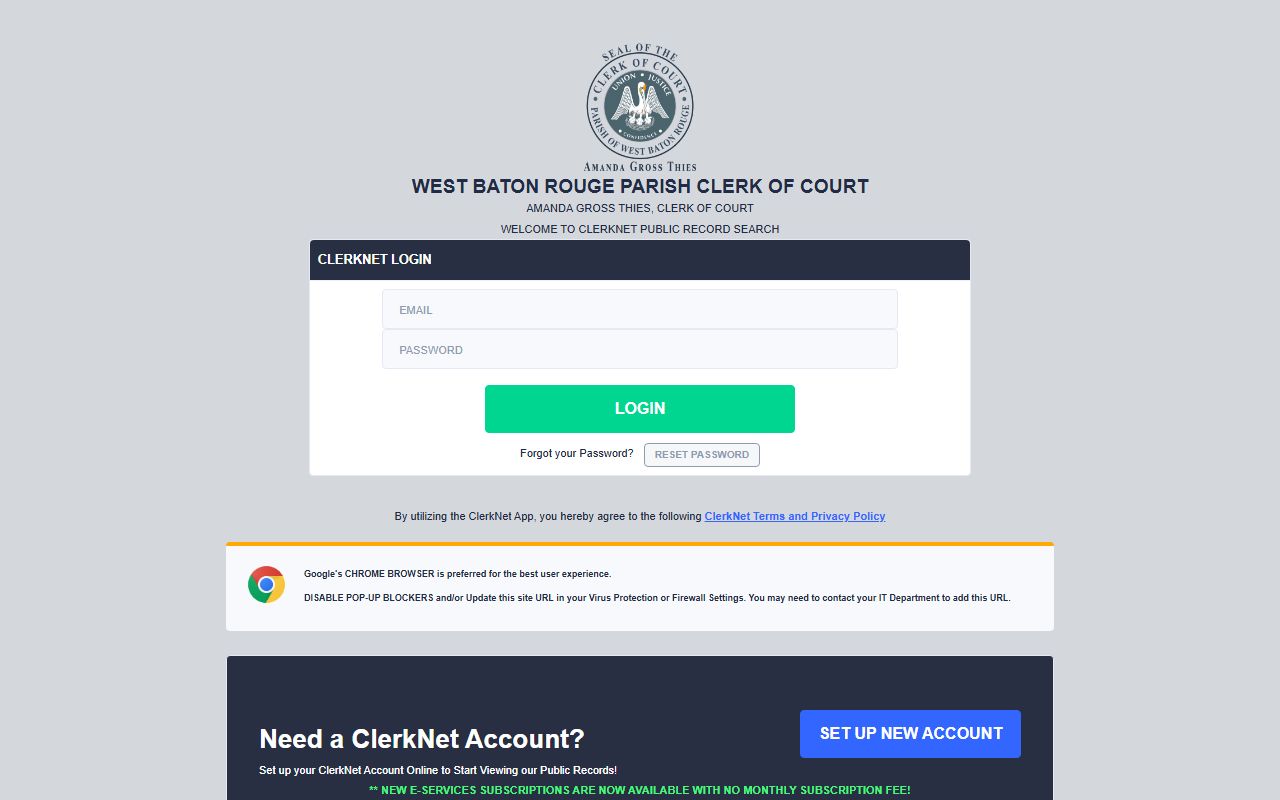
The portal screenshot supports routing criminal case lookup to the clerk-linked system rather than to the jail roster.
Charges Filed After Arrest
The West Baton Rouge Clerk of Court criminal department says it receives and files all formal charges and later pleadings brought before the 18th Judicial District Court. The clerk also says criminal records include charges evidenced by Bills of Information, minute entries, and other documents. A Bill of Information is a Louisiana prosecutor-filed charging document. An indictment comes from a grand jury. A complaint or affidavit may support the arrest or early proceedings, but the clerk's criminal file is the place to verify filed district-court charges.
| Document | Who Uses It | What It Means |
|---|---|---|
| Complaint or affidavit | Law enforcement or prosecutor | Supports arrest, probable cause, or early case action. |
| Bill of Information | District attorney | States the formal charge the prosecutor files in court. |
| Indictment | Grand jury | Charges a case through grand-jury action, often for serious offenses. |
West Baton Rouge Parish Prosecutor Role
The 18th Judicial District Attorney's Office serves West Baton Rouge, Iberville, and Pointe Coupee. The DA is Tony Clayton, and the office's West Baton Rouge phone is listed as 225-336-2410. The prosecutor decides how to proceed after an arrest based on the evidence, charge law, witness input, and court rules. That is why the charge listed at booking may later be declined, amended, reduced, or replaced by a different formal charge in the court record.
Victim and witness issues may also route through the DA, while custody status should stay with the jail or VINE. The DA site includes prosecution process, misdemeanors, felonies, pre-trial diversion, juvenile, bond forfeitures, public-records request, expungement, and victim/witness assistance resources. Those topics are court-case resources, not proof that a person remains in custody.
West Baton Rouge Charge Status
Charge status can change as a court record develops after arrest. A pending charge has not reached final disposition. An amended charge was changed from the earlier wording or grade. A reduced charge was lowered to a lesser offense. A dismissed charge was ended by court or prosecutor action. Nolle prosequi means the prosecutor declined to proceed on that charge. A guilty plea is an admission, while a conviction is a final adjudication and is not the same as an arrest.
| Status | What It Means |
|---|---|
| Pending | The case or charge remains active. |
| Amended | The filed charge was changed after review or court action. |
| Reduced | The charge was lowered to a lesser offense or grade. |
| Dismissed | The charge was ended by court or prosecutor action. |
| Nolle prosequi | The prosecutor declined to proceed with that charge. |
| Conviction | A final guilty finding by plea or verdict. |
Bond After a West Baton Rouge Arrest
Official local bond fee tables and accepted payment methods were not located in the accessible parish pages. The researched path is to confirm custody on the roster or by calling the booking desk at 225-346-6420, then ask whether bond is set, what payment methods are accepted, and whether a hold blocks release. A person can appear bond eligible on one charge but still remain in custody because of a bench warrant, non-support warrant, parole or probation hold, DOC hold, federal hold, ICE detainer, or another parish warrant.
| Bond Type | How It Works |
|---|---|
| Cash bond | Money is deposited with the court or jail when allowed by current rules. |
| Surety bond | A licensed bondsman posts the obligation for a fee. |
| Personal recognizance | The court allows release on a promise to appear. |
| No-bond hold | Release is not allowed on that hold until the controlling authority changes it. |
Warrants Before or After Arrest
The West Baton Rouge Parish Warrants Division manages arrest warrants for non-support, bench warrants, criminal warrants issued in the parish, and warrants forwarded from other agencies. It also serves as the central repository for arrest documents. No public active-warrant search table was located in official accessible sources, so phone and records request channels are the practical route. Warrants can lead to a jail booking, and the booking can then produce a roster entry.
For sheriff warrant questions, use the Warrants Division line at 225-389-2309 or the Criminal Records/Warrants contact at 225-389-2306. For a bench warrant tied to a district-court criminal case, ClerkNet and the clerk criminal department matter because the clerk says it issues subpoenas and bench warrants and posts documents into the criminal database.
The official warrants page identifies the warrant categories and direct contact channel for West Baton Rouge Parish.
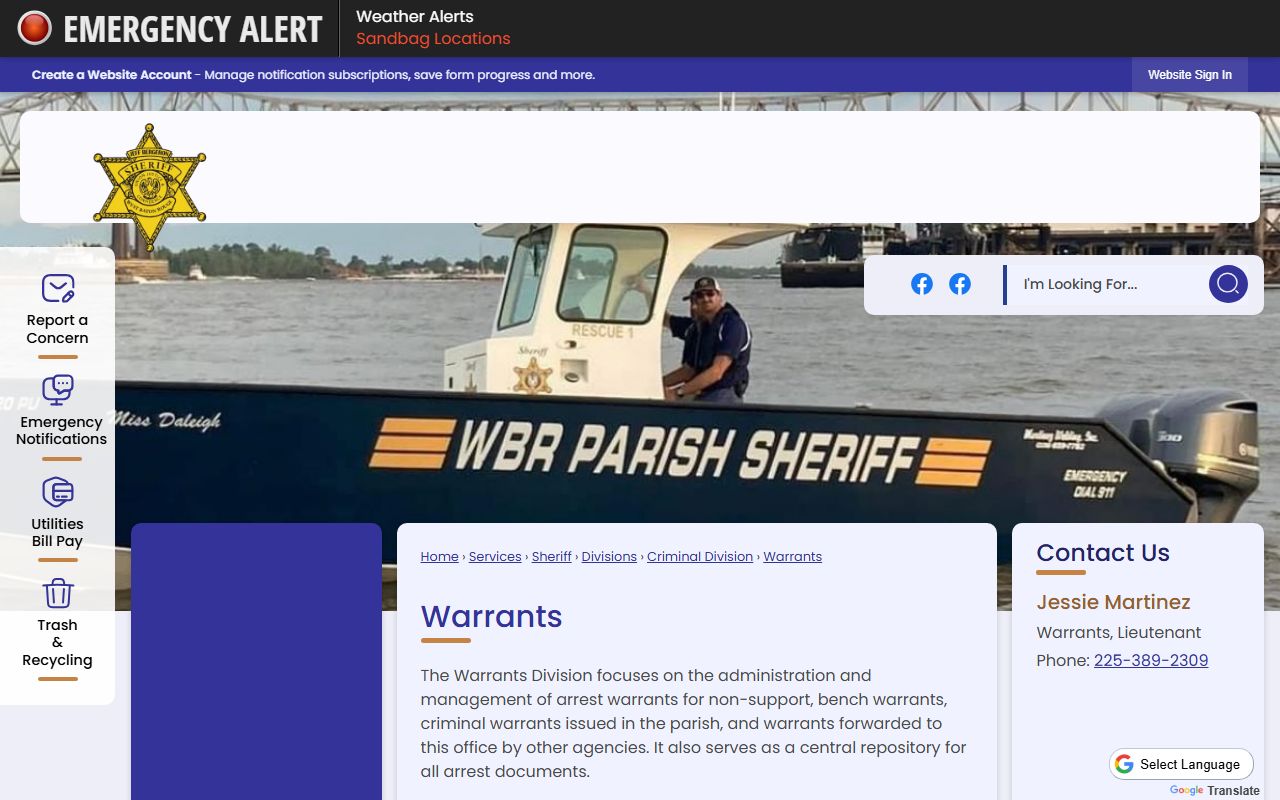
The screenshot reinforces that warrants are a sheriff records function and can overlap with court records after arrest.
Charges vs Convictions
A charge is an accusation. A conviction is a final outcome after a plea or verdict. West Baton Rouge Parish court records after a jail arrest may show both at different stages, but they should not be treated as the same fact. Court records can also show dismissed charges, amended charges, or pending charges that have not reached judgment.
| Charge | Conviction | |
|---|---|---|
| Stage | Accusation filed or pursued after arrest | Final guilty result by plea or verdict |
| Meaning | The case is alleged and still may change | The court has reached a final criminal outcome |
| Where shown | ClerkNet, minutes, charging document | Disposition or judgment in the court record |
Sealed and Expunged Arrest Records
Louisiana expungement law is specific. Louisiana Code of Criminal Procedure art. 971 says expungement removes a record from public access but does not destroy it. The record can remain available to law enforcement and other authorized agencies. Article 983 addresses expungement costs and processing fees, with costs generally not exceeding 550 dollars unless an exception applies.
| Sealed | Expunged | |
|---|---|---|
| Public view | Access is limited by court order or law. | Removed from public access under Louisiana expungement rules. |
| Record existence | The record still exists. | The record is not destroyed under art. 971. |
| Authorized access | May remain available to authorized users. | May remain available to law enforcement and other authorized agencies. |
Restricted Court Records After Arrest
Louisiana R.S. 44:31 starts from public access, but law-enforcement, prosecutive, and investigative records have specific limits. Juvenile records, sealed matters, active investigative files, expunged records, and nonpublic material separated by a custodian may not be available in the same way as ordinary criminal minutes or filed charging documents. When the custodian questions whether a record is public, R.S. 44:32 requires a written determination within five business days.
Important: Casual court lookup is not a consumer report and must not be used for FCRA-covered screening decisions.